
March in my corner of Europe is not just a time when nature wakes up. It’s a moment where every bird species plays a different role. I feed the birds all year round, and what I see from my terrace chair beats many a nature documentary.
Blackbirds are the true masters of the house. Recently, I had the chance to witness their ritual mating dance. It’s an incredible sight: the pair circles each other with beaks proudly held high and wings spread to the sides, emitting a loud, almost aggressive screeching. This isn’t just flirtatious chirping – it’s a tough negotiation and a display of strength. Interestingly, blackbirds are the only birds in my garden that will chase away a tit or a robin—just on principle. Even though they have a completely different menu, they like to show who’s boss. The only neighbors they respect are the wood pigeons, they simply give them a wide berth. Blackbirds visit me mainly to dig through the mulch in my garden beds. It’s their favorite restaurant, where they always find something protein-rich.
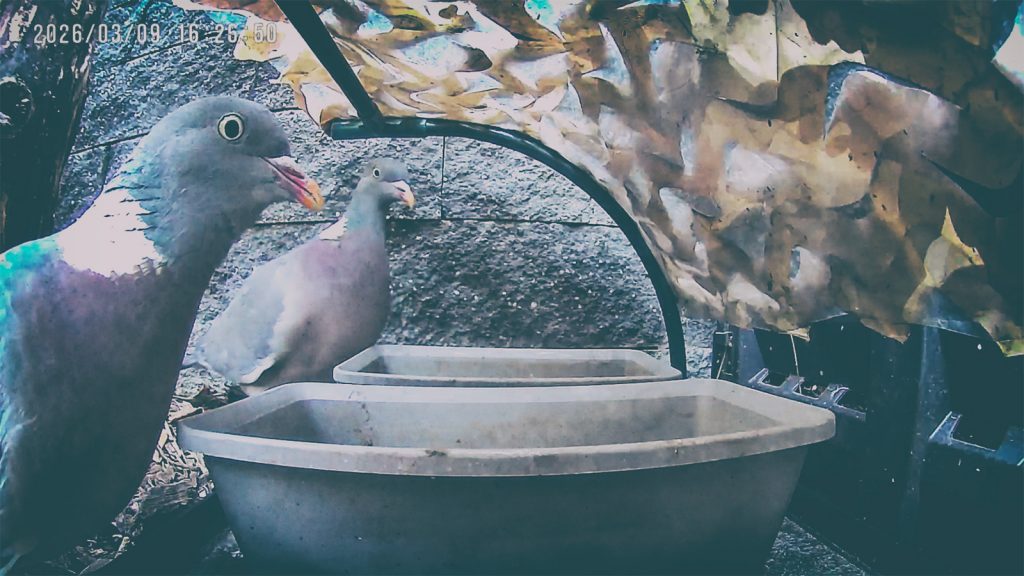
My wood pigeons are a fascinating example of avian loyalty. I’ve noticed an interesting pattern: the male stays with me all winter, guarding the territory, while the female and the young likely fly off to warmer regions. Now, in March, they are a pair again! I’m almost certain it’s the same couple from last year. I’ve prepared a special ground feeder for them, where I serve rolled oats and nuts. When they eat, there must be absolute silence—they are incredibly skittish. But it’s worth the wait to see their summer “shift system” at the nest: him in the morning, her in the evening.
The robin’s story is a special one. Last year, he disappeared at the end of February—probably off to find a mate. This year he is still alone, so he sits under the terrace roof all day, singing softly to himself. It sounds like he’s humming under his breath out of boredom, waiting for springtime love. For now, I am his main partner. Whenever I stick a shovel into the ground, he reports for duty right beside me. I hand him small earthworms, and he gently takes them with his beak and breaks them up on a stone. This bird has completely lost his fear of humans, knowing that nothing threatens him here.
Great tits and blue tits are the smallest but loudest residents of the garden. I distinguish the great tits by the shades on their bellies—some are distinctly yellow, others more grey. Although they are afraid of every shadow, they are incredibly useful, picking caterpillars off my gooseberries.
The real show begins, however, when a magpie appears in the garden. The tits then raise an incredible ruckus, alarming the whole neighborhood. That’s when the blackbird leaps into action—he flies at the magpies with full force, trying to drive them away. And the wood pigeon? He just sits calmly on the roof, watching the whole affair from above, completely unbothered.
Many people are surprised that I don’t put the bird feeder away in the spring. I provide nuts, dried mealworms, and rolled oats. Why? Because I believe that year-round feeding significantly increases the breeding success of my guests. I read on the British Trust for Ornithology website that birds with access to a steady food source spend less energy foraging for themselves. This allows them to provide their chicks with more natural, high-protein food like caterpillars. My tits are the best proof of this—a quick mealworm from the feeder gives them the “boost” they need for their work in the field.